

Latest Version: 5.2.1-1
The application has the following infrastructure:
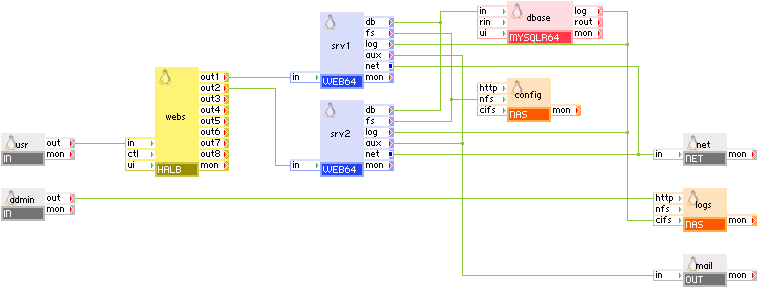
This application is a fully featured, scalable, CRM implementation. The application functionality is provided by SugarCRM's Sugar Community Edition 5.2.0 (http://www.sugarcrm.com/crm/). This version of SugarCRM is licensed under GPLv3. The scalable infrastructure is built using CA AppLogic® for System z and CA AppLogic® for System z's catalog appliances.
Sugar Open Source enables sales, marketing, and support organizations to manage their customer interactions more efficiently and profitably and is intended for both large and small companies.
For administration and user guides see the SugarCRM website.
The SugarCRM application is packaged as an appliance. All required configuration is exposed on the boundary of the application, so that the application can be configured as a single appliance (using the Application Configuration property sheet in the editor).
Properties
These are the only settings that you must configure to start a new copy of the application. Certain settings are automatically distributed to multiple appliances (such as the DNS servers, the admin e-mail, and so on). You don't need to understand the internal structure of the application to be able to configure it.
|
Property Name |
Type |
Description |
|
usr_ip |
IP |
This is the IP address at which the application provides services to users. This property is mandatory. |
|
admin_ip |
IP |
This is the IP address at which the application administrator can access the logs. This property is mandatory. |
|
out_ip |
IP |
This is the IP address that the mail gateway is going to use to send e-mail from. This property is mandatory. In the future, we may provide auto assignment of IP addresses to output gateways. |
|
net_ip |
IP |
This is the IP address that the NET gateway is going to use. This property is mandatory. |
|
netmask |
IP |
Netmask for the network on which usr_ip, admin_ip and out_ip reside. This property is mandatory. |
|
gateway |
IP |
Address of IP gateway to be used to route traffic. This property must be specified to access the SugarCRM application from hosts outside of the IP network on which SugarCRM is running (that is, most cases). Use 0.0.0.0 to disable. This property is mandatory. |
|
dns1 |
IP |
IP address of a DNS server for host name resolutions. Used to resolve the mail server name. This property is mandatory. |
|
dns2 |
IP |
IP address of a backup DNS server for host name resolutions. Used to resolve the mail server name. Default: 0.0.0.0 |
|
mail_server |
String |
Host name of the SMTP mail server through which SugarCRM should send e-mail notifications of bug changes. The mail server can be specified as a host name (for example, mail.CA.com) or as an IP address (for example, 12.34.56.78). Default: 0.0.0.0 (mail is disabled). |
|
allowed_hosts |
String |
List of hosts or subnets allowed to connect. Separate multiple entries with spaces or commas. Supported format example: 192.168.1.2 192.168.1.0/24 192.168.2.0/255.255.255.0. Default: 0.0.0.0/0 (all allowed) |
|
denied_hosts |
String |
List of hosts or subnets to be denied connection. The format is the same as for allowed_hosts. Default: (empty) (none denied) |
|
admin_email |
String |
E-mail address of the application administrator. This address is used in web pages generated by the servers on error. Default: root@localhost.com |
|
usr_hostname |
String |
Host name under which the application is accessible. This is the name that users point their browsers at: http://usr_hostname/. This name should resolve to the IP address specified in usr_ip. Default: localhost |
|
admin_user |
String |
This is the user name of the administrator. This name is required to access the logs. Default: admin |
|
timezone |
String |
Specifies the time zone used in the application. If this property is empty, the timezone is not modified and left as-is. A list of supported time zones is available here. Default: empty |
|
mon_standby |
Int |
Determines whether application monitoring is disabled upon application start. If non-zero, monitoring is disabled, otherwise monitoring is enabled. The monitoring can be enabled at runtime by manually starting the mon appliance. Default: 1 (monitoring is disabled). |
Important! The IP addresses configured in the usr_ip, admin_ip and out_ip properties must be IP addresses available on your CA AppLogic® for System z grid. You can find them, together with the netmask, gateway and DNS servers on the dashboard of your grid. We are working to make it possible for CA AppLogic® for System z to provide these addresses automatically.
Resources
|
Resource |
Minimum |
Maximum |
Default |
|
CPU |
0.8 |
112 |
2.05 |
|
Memory |
1.218 GB |
200 GB |
3.062 GB |
|
Bandwidth |
10 Mbps |
20 Gbps |
1.45 Gbps |
User Volumes
The application itself uses several volumes. They are part of the application and are already configured into the appliance instances. There are no volumes that need to be configured on the application boundary.
Administrator Login Information
Initially the only account setup on the application is the administrator. The administrator must log in and create any needed user accounts.
|
user |
password |
|
admin |
3tSugar |
User Login Information
Users of the SugarCRM application can access it at the address defined by the usr_ip address.
There are no predefined users built into the application. User accounts can be created by logging in with the Administrator account listed above.
IT Administrator Login Information
The IT administrator of the SugarCRM application can access the logs using a browser. The logs are accessible at the address defined by the admin_ip.
If you intend to use this application in a production environment you may want to increase the size of the data volume by creating new application volume of a larger size (more users require more disk space) and copying the data volume onto it. Then simply assign the new volume to the dbase appliance and restart the app.
|
Copyright © 2013 CA.
All rights reserved.
|
|