

The MGT (Metering Gateway Application) provides a point for metering data aggregation for all grids within a single datacenter and communicates to the CA basic metering server (BMS) publicly over a single HTTPS connection.
For installations that cannot communicate to the BMS, the MGT provides a gateway through which grids running in a single datacenter can report license and metering data to BMS. This is useful for datacenters that are private or isolated from publicly routed networks, such as the Internet or where business or security policies restrict the SSH protocol from traversing a firewall.
The MGT provides an input interface which allows grids in the datacenter to use SSH or HTTPS to report their metering data. In addition, it implements an output interface through which it reports metering data to the BMS over HTTPS though port 443.
Metering data is reported once a day at a specified time parameterized through a property. If the MGT fails to report the metering data at the specified time, it retries sending the data every hour and logs a message to the grid dashboard. Once the metering data is successfully reported to BMS, the MGT archives and retains the data for a parameterized amount of time. When that time is exceeded, the MGT permanently deletes the metering data.
The MGT serves a single metering account. If multiple accounts need to be operated in the same datacenter, you must run multiple MGT applications.
The MGT is configured with the account name as well as the SSH public key required for grids to report their data. A simple menu-driven interface is provided for managing the SSL certificate used for communicating with the BMS. You access the interface by logging into the running application.
For additional information on integrating the MGT application and metering server commands, refer to the Metering Service Reference.
|
Resource |
Minimum |
Maximum |
Default |
|
CPU |
0.35 |
32 |
1.35 |
|
Memory |
567 M |
40.125 GB |
1.343 GB |
|
Bandwidth |
5 Mbps |
10 Gbps |
1.1 Gbps |
The application uses a single data volume to store and retain the metering data received from grids that report to MGT. This volume is part of the application and configured into the appliance instance that uses it.
However, the volume should be resized before the application is started for the first time. You should resize the volume to ensure the volume can hold at least 30 days of metering data for all grids that report their metering data to MGT. This should be approximately 10 MB per grid.
|
Property Name |
Type |
Description |
|
in_ip |
ip addr |
IP address at which the application provides services to grids in the datacenter. This property is mandatory. |
|
in_netmask |
ip addr |
Network for the network on which in_ip resides. Default: 255.255.255.0 |
|
in_gateway |
ip addr |
Address of the IP gateway used to route traffic. This property must be specified in order to access the MGT application from hosts outside of the IP network on which MGT is running (i.e., most cases). Use 0.0.0.0 to disable.Default: 0.0.0.0 |
|
in_allowed_hosts |
string |
List of hosts and/or subnets allowed to connect. Separate multiple entries with spaces or commas. Supported format example: 192.168.1.2 192.168.1.0/24 192.168.2.0/255.255.255.0. Default: 0.0.0.0/0 (all allowed) |
|
out_ip |
ip addr |
IP address of the public interface of the MGT application. This property is mandatory. |
|
out_netmask |
ip addr |
Netmask of the public interface of the MGT application. Default: 255.255.255.0 |
|
out_gateway |
ip addr |
Default network gateway for the public interface. This property is mandatory. |
|
dns1 |
ip addr |
IP address of a DNS server for hos name resolutions. Used to resolve the metering server name. This property is mandatory. |
|
dns2 |
ip addr |
IP address of a backup DNS server for host name resolutions. Used to resolve the metering server name. Default: 0.0.0.0 |
|
datacenter_name |
string |
Customer datacenter name. This property is mandatory. |
|
account_name |
string |
Customer account name. This property is mandatory. |
|
account_pub_key |
string |
Customer public SSH key. If not set, the grids report their metering data to MGT over HTTPS. |
|
report_hour |
integer |
Hour at which the MGT is scheduled to report its metering data to the metering system. The value may be 0 through 23. Default is 12 (12 noon). |
|
retention_days |
integer |
Number of days MGT is to retain archived metering data. Once the number of days has expired, the metering data is permanently deleted. If set to 0, no metering data is not retained and is permanently deleted once it has been successfully reported to the metering system. Default is 30. |
Note: The IP addresses configured in the
in_ip
and out_ip properties must be IP addresses available on your grid. You can locate valid IP addresses as well as netmask, gateway and dns servers on the dashboard of your grid.You can install and configure the MGT application, then setup the SSL certificate and configure the grid to use the MGT.
Install and Configure MGT Application
The grid on which the MGT application is running must have access to the internet since MGT communicates with the CA basic metering server.
Follow these steps:
app import MGT mgt-version.tar.bz2
vol resize MGT:data size=3G
Execute the following command:
app config MGT --boundary
Configure the parameters.
Execute the following command:
app start MGT
Setup the Client-side SSL Certificate
You can setup the SSL certificate that MGT uses to authenticate itself with the metering server.
Follow these steps:
app login MGT
The following simple text menu with options to manage the SSL certificate displayed.
Metering Gateway Maintenance Utility
   A. Set Client SSL certificate
   B. Delete current SSL certificate
   C. Display current SSL certificate
   D. Test notifications
   Q. Exit
Configure Grids to use MGT
You must configure new and existing grids to report their metering data to the MGT application.
Follow these steps:
The account_srv parameter is a backbone setting that affects all grids.
MGT may log the following messages to the dashboard of the grid. In addition, a message is logged to the system log of the grid controller and the system log of the Metering Gateway appliance (MGT:main.mgt).
|
Message |
Description |
|
Grid metering data could not be sent to CA. Please contact support for immediate assistance. |
MGT is unable to report the grid metering data to CA for at least the last 72 hours. |
|
Grid metering data could not be sent to CA due to internal error, please contact support for assistance. |
An error occurred in MGT when attempting to send metering data to CA. |
|
Account account is disabled. No new grids may be installed or upgraded. Please contact support for immediate assistance. |
The user account has been disabled by CA. |
|
Verification of account account failed. Please contact support for assistance. |
CA cannot verify the specified account. This could be caused by one of the following reasons: incorrect account name or invalid SSL certificate |
|
Metering Gateway data volume is low on disk space. |
There is less than 10 MB of available disk space on MGT data volume. The data volume needs to be resized. |
|
This is a test message from the Metering Gateway for account account. |
This message is logged by MGT to verify if can post a message to the grid dashboard. |
Application Architecture
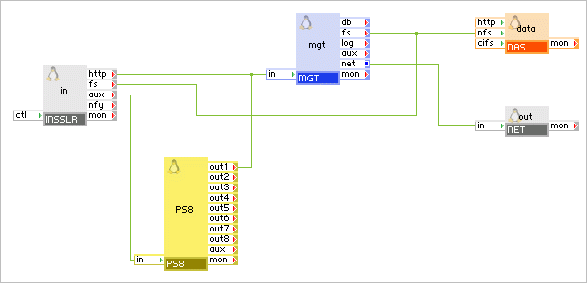
This is a reference design for the Metering Gateway Application
It has the following components:
The application infrastructure displays below:
Application Volumes
The MGT application has the following volumes:
|
Volume Name |
Description |
|
data |
Shared file system holding metering data. This volume is configured as the data volume of the NAS appliance. |
The following open source and third party packages are used in addition to that software found on the MGT appliance base class WEB5.
|
Software |
Version |
Modified |
License |
|
Perl-IPC-Run |
0.80-2 |
No |
Artistic |
|
Perl-Sort-Naturally |
1.02-1.2 |
No |
Artistic |
|
Copyright © 2013 CA Technologies.
All rights reserved.
|
|