

This section describes the configuration of local and global directory services.
Each grid includes a local directory service. This service is used to manage local users and groups. It is also used to store some information about global users and groups. For example, when a global user authenticates, that user’s global group membership is read from the global directory and cached in the local directory. Global user profile properties are also stored in the local directory.
Users and groups are managed using the CLI user and group commands.
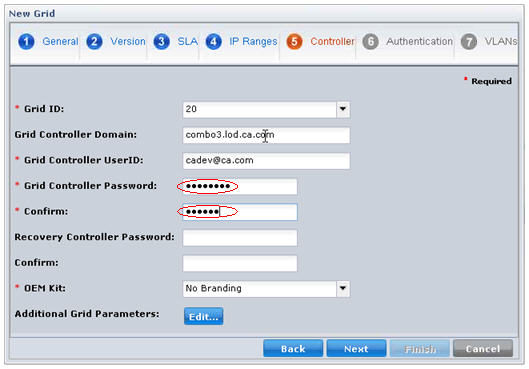
When a grid is first created, BFC is used to create an initial local user. This user is made a member of the local group admin. The initial user name and password are provided in the BFC GUI:
A global directory service is managed outside of CA AppLogic®. A CA AppLogic® grid can be configured to use a global directory service for user authentication and defining global group membership. Using a global directory service has the following benefits to:
Configuration of the interaction of CA AppLogic® with a global directory service is performed using the backbone fabric controller (BFC). This configuration is protected and can only be changed by the maintainers of the backbone fabric controller. BFC can be used to perform this configuration at the time of grid creation or any time thereafter. CA AppLogic® supports both Active Directory and generic LDAP directory services.
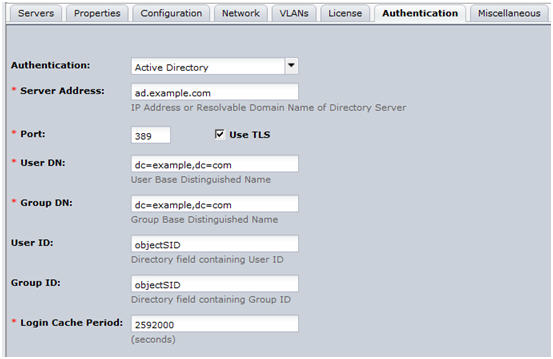
The following graphic shows a typical configuration that uses Active Directory as a global directory service.
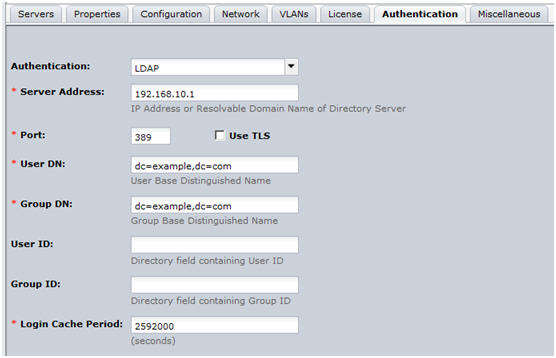
The following graphic shows a typical configuration that uses generic LDAP as a global directory service.
Changes made in the BFC global directory configuration interface take effect as soon as they are propagated to the grid—no controller or grid reboot is required. The following constraints affect grid inter-operation with a global directory service:
Note: See configuring authentication for more information.
|
Copyright © 2012 CA.
All rights reserved.
|
|