

Latest Version: 2.0.4-1
Latest Version: 2.0.4-1
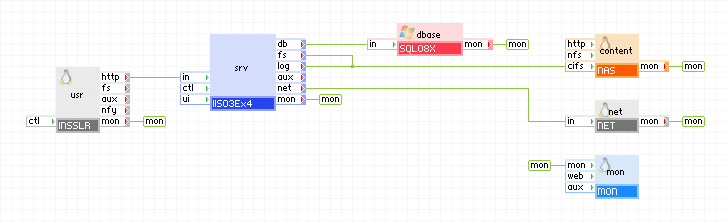
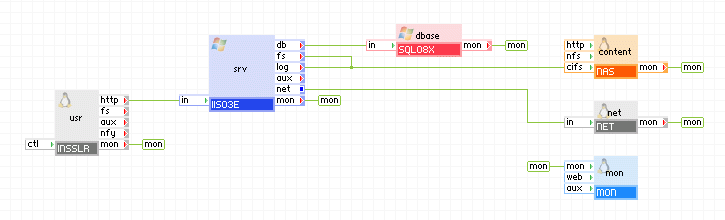
The WISA and WISAx4 reference applications are two-tier web applications that allow you to easily port your applications.
The WISA application consists of a single web server, database server, file server, gateway for external network access, and input gateway for user access. The application also contains a monitor that the maintainer can use to monitor application data (for example, CPU/memory usage, website hit rate, and so on).
The WISAx4 adds a load-balanced web tier that contains a load balancer and four web servers. WISAx4 is designed for applications that incur heavy traffic, such as being accessed by hundreds of users.
Important! WISA and WISAx4 are not automatically installed on a grid. See the installation reference for more information.
|
Property Name |
Type |
Description |
|
in_ip |
IP |
IP address where the WISA application provides services to users. This property is mandatory. |
|
out_ip |
IP |
IP address used by the WISA application to access an external network outside of the application (that is, the internet). This property is mandatory. |
|
netmask |
IP |
Network mask for the network on which in_ip and out_ip reside. This property is mandatory. |
|
gateway |
IP |
Defines the IP network gateway (router) for all outgoing traffic to the external network using in_ip and out_ip. This property is mandatory. |
|
dns1 |
IP |
IP address of the primary DNS server used for host name resolutions. This property is mandatory. |
|
dns2 |
IP |
IP address of the backup DNS server used for host name resolutions. Default: empty (not used). |
|
mon_standby |
Int |
Specifies whether application monitoring is disabled upon application start for the WISA application. If non-zero, monitoring is disabled. If zero, monitoring is enabled. The monitoring can be enabled at runtime by manually starting the mon appliance. Default: 1 (disabled). |
|
srv2_standby |
Int |
Specifies whether the second IIS server is in standby mode. If non-zero, the second IIS server is in standby mode. If zero, it is not in standby mode. This property is valid only for the WISAx4 application. Default: 1 (standby mode). |
|
srv3_standby |
Int |
Specifies whether the third IIS server is in standby mode. If non-zero, the third IIS server is in standby mode. If zero, it is not in standby mode. This property is valid only for the WISAx4 application. Default: 1 (standby mode). |
|
srv4_standby |
Int |
Specifies whether the fourth IIS server is in standby mode. If non-zero, the fourth IIS server is in standby mode. If zero, it is not in standby mode. This property is valid only for the WISAx4 application. Default: 1 (standby mode). |
Important! The IP addresses configured in the in_ip and out_ip properties must be IP addresses available on your grid. You can find them, and the netmask, gateway, and DNS servers on your grid dashboard.
WISA
|
Resource |
Minimum |
Maximum |
Default |
|
CPU |
0.75 |
68 |
2.45 |
|
Memory |
2.375 GB |
166 GB |
2.781 GB |
|
Bandwidth |
6 Mbps |
10.5 Gbps |
950 Mbps |
WISAx4
|
Resource |
Minimum |
Maximum |
Default |
|
CPU |
1.6 |
108 |
3.451 |
|
Memory |
4.718 GB |
390 GB |
4.906 GB |
|
Bandwidth |
10 Mbps |
18.5 Gbps |
1.4 Gbps |
The application itself uses several volumes which are already part of the application and are configured into the appliance instances.
|
Volume |
Description |
|
sql_data |
Volume for the database data storage. This volume is assigned to the SQL08y appliance. By default, an empty volume named SQL is supplied for the application to use. |
|
fs_data |
Volume for storing the WISA application web pages, code, scripts, and anything else that is required by the application. It is also used to store the web server logs. This volume is assigned to the NAS appliance. By default, an empty volume named fs is supplied for the application to use. |
|
mon_data |
Volume for storing monitoring data for the application. You should not access or modify this volume. This volume is used internally by the MON appliance. |
This section describes how to use and operate the WISA applications. It is geared towards both administrators and regular CA AppLogic® users. The initial setup and maintenance of the WISA applications requires access to a CA AppLogic® grid.
WISA and WISAx4 are designed to allow the user to quickly port their application over to CA AppLogic®.
Initial Application Setup
Use the following steps to get your own WISA application up and running on a CA AppLogic® grid.
To run a WISA application on a CA AppLogic® grid
app provision WISAx4_r3 mywisaapp in_ip=1.2.3.4 out_ip=1.2.3.5 netmask=255.255.255.0 gateway=1.2.3.1 dns1=1.2.3.50 dns2=1.2.3.51 mon_standby=0 srv2_standby=0 srv3_standby=0 srv4_standby=0 fs.size=250MB sql.size=3GB
CA AppLogic® will provision the mywisaapp application and start it on the grid.
You can now access your application using a browser.
Application does not serve any page prior to loading content, so if you have not setup web content yet - application should return an error page (for example, 503). If you do not see web response on this stage, verify your IP addresses are configured correctly and restart the application if needed.
You now have a running WISA application on your grid.
Your application will be ready to go.
Install Your Application
WISA applications are designed to allow you to quickly port your existing applications to a CA AppLogic® grid.
To install your own software on your WISA application, SSH into the web appliance from within the CA AppLogic® shell: ssh mywisaapp:main.srv1
After all of your software is installed and configured, there is no need to restart the application (unless the software you installed requires a reboot).
You should now be able to access your application by using the configured hostname or IP address (in_ip).
Serve Dynamic Content from the Remote Filesystem
To serve dynamic content from the remote file system share, each IISx appliance in the application must configured as given in the following procedure.
To configure each IISx appliance in the application
Monitor Your Application
After your application has started, you can monitor the application by using the monitor GUI accessible through the CA AppLogic® GUI.
To monitor your application, do one of the following:
If you started your application with the monitor in standby state, you can manually start it at runtime: comp start mywisaapp:main.mon. The monitor must be started before you can access it through the CA AppLogic® GUI.
After the monitor has started, you may now access the monitoring GUI to monitor your application. This is used to monitor CPU/memory usage, number of hits your website is getting, traffic load, and so on.
Note: The mon appliance properties are not configured by default; See the MON datasheet on how to configure mon for things like setting the monitor title, enabling background alarms, and so on.
|
Copyright © 2012 CA.
All rights reserved.
|
|