

Note: Implementation of Callouts is optional.
If you have implemented a Callout, then CA Risk Authentication Server reads all configurations related to the Callout from the database and caches the information on startup. During a transaction:
Note: The Callout framework is a part of CA Risk Authentication Server and just like any other CA Risk Authentication Evaluation rule, is loaded during the Server startup. It is implemented as a .dll or .so file.
Note: CA Risk Authentication supports both one-way and two-way SSL-based connections between CA Risk Authentication Server and your Callout in case of HTTPS data.
The Callout framework now waits for a response from the Callout.
If the response from your Evaluation Callout is received within a specified time-out period, then the framework parses the response and sends the result to CA Risk Authentication Server.
If the response is not received within the specified time-out period, then the framework returns FAILURE as the rule result and empty strings ("") for the modifier and annotation.
Note: The time-out period can be configured by using CA Advanced Authentication.
The following figure illustrates the interaction between CA Risk Authentication Server, Callout Framework, and your Callout.
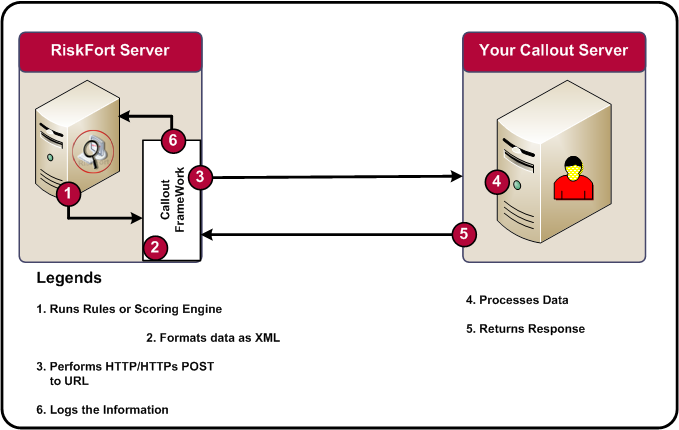
Note: If you are implementing an Evaluation as well as a Scoring Callout, then you can either implement them on the same server or on separate servers.
|
Copyright © 2014 CA Technologies.
All rights reserved.
|
|