

Designing Functions › Action Diagrams › Overview of Action Diagrams
Overview of Action Diagrams
An action diagram contains the processing steps that make up a function. Each action diagram consists of a list of actions, where each action may be either a call to another function or one of a number of low level built-in functions; for example, *ADD.
The sequence in which actions are executed is controlled by three simple constructs: sequential, conditional, and iterative. The constructs specify a list of actions, and optionally, when and how to execute those actions. Constructs are the basic building blocks of an action diagram. They are always executed from top to bottom. In addition, constructs may be nested; in other words, an action within a construct may be another construct.
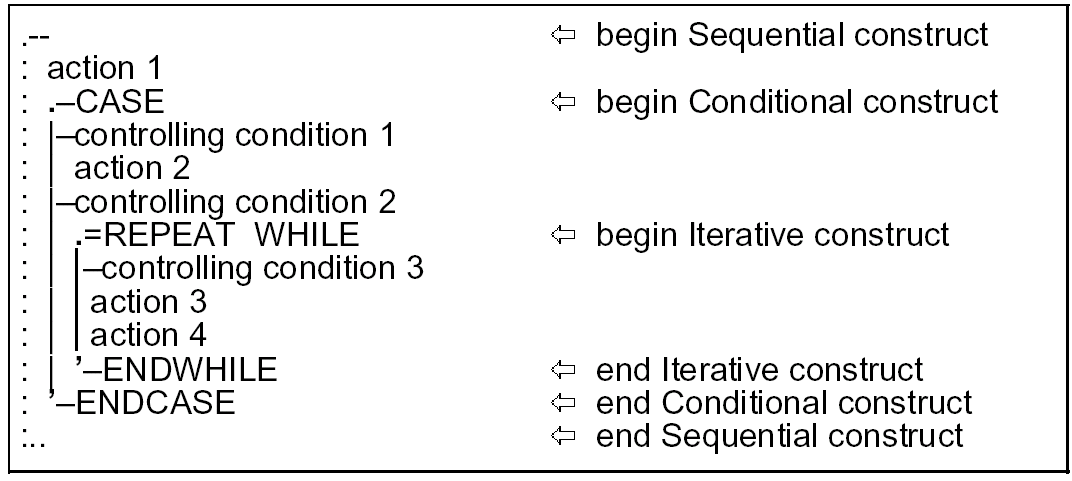
Following are brief descriptions of each of the three constructs and the way in which each is shown on the action diagram. Refer to the diagram following these descriptions as you read.
- Sequential construct—A sequential construct is the simplest construct. It is a list of actions or other constructs to be executed in the order in which they appear in the action diagram. It is shown on the action diagram enclosed by a bracket of dots (:).
- Conditional construct—A conditional construct specifies a condition and a series of actions to be taken if the condition is true. It is equivalent to an IF THEN ELSE logic statement or a SELECT set. This construct appears on the action diagram between CASE and ENDCASE statements and is enclosed by a bracket of broken vertical bars (|). You can specify several mutually exclusive conditions in a single conditional construct.
- Iterative construct—An iterative construct includes a list of actions that are to be executed while an initial condition is true. It is equivalent to a DO WHILE logic statement. An iterative construct appears on the action diagram between REPEAT WHILE and ENDWHILE statements. It is indented and enclosed by a bracket of solid vertical bars (|). The controlling condition is specified at the beginning of the bracket.
The following diagram shows the general structure of a CA 2E action diagram and the three constructs.
Copyright © 2014 CA Technologies.
All rights reserved.
|
|