

IBM i General Design Standards › Design Standards for Database Files › The Database of iSeries › Normalization
Normalization
Normalization is a process that can be applied to data relations to ensure that they are structured in ‘normal form’. It can be shown that relations in normal form will satisfy certain basic criteria, such as non-redundancy, which are desirable when representing data on a computer.
There are in fact several different normal forms, each representing a stage of increasing rigor. Each successive stage encompasses the previous stage, thus ‘Third normal form’ includes ‘Second normal form’, which in turn, includes ‘First normal form’.
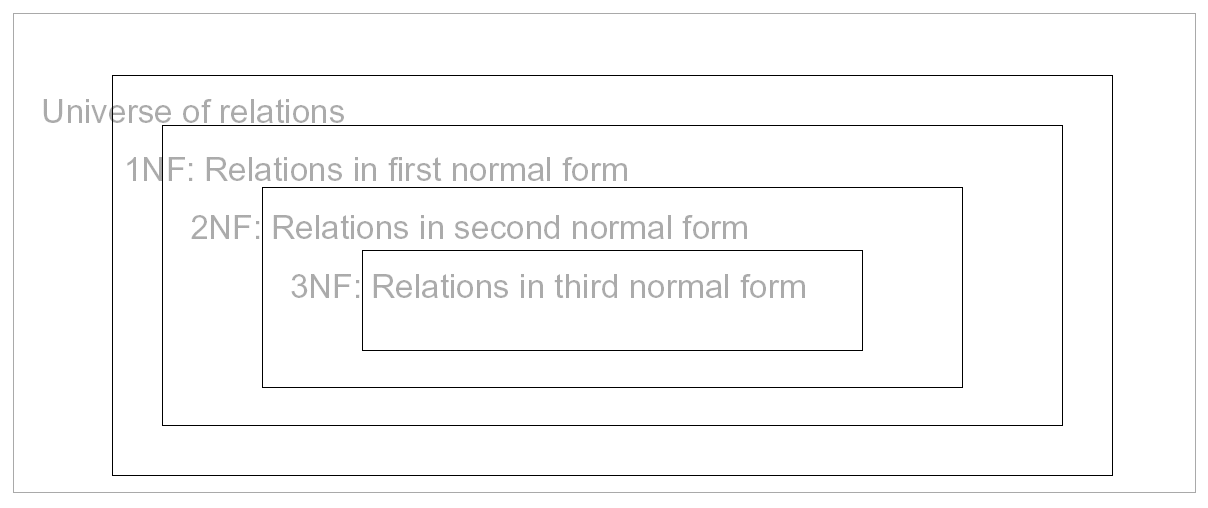
The steps of normalization can be outlined in a non-technical language by using the term ‘field’ rather than the more correct attribute as follows:
- To be in first normal form, every field must represent an atomic set of values. A field should not, for example, contain both customer code and customer type (either concatenated or as alternatives).
- To be in second normal form, every non-key field in the table (for example, record) must depend on the prime key. For example, properties of customer type should be on a separate customer type entity, and not be repeated on every customer instance.
- To be in third normal form, every non-key field must be:
- mutually independent of the other non-key fields (it can, for instance, be updated independently of the other non-key fields)
- fully dependent upon the prime key
Copyright © 2014 CA.
All rights reserved.
|
|