Managing CA Business Intelligence Reports › Key Performance Indicators › System KPIs
System KPIs
System KPIs enable you to collect metric data related to the operation of CA Service Desk Manager processes.
The following process types are supported:
- domsrvr—The CA Service Desk Manager Object Manager (server process). The Object Manager also caches various records and tables for clients.
- bpvirtdb—The BOP Virtual Database server enables operation of multiple Object Managers in the CA Service Desk Manager environment. All Object Managers running on primary or secondary servers connect to the virtual database, which arbitrates their access to database agents. For example, when retrieving a new range of ticket reference numbers, the virtual database ensures that only one Object Manager at a time accesses the table containing the reference numbers. The virtual database also performs caching of database information for Object Managers.
- db_agents—Database agents perform SQL queries, and handle other interactions between CA Service Desk Manager and the database management system (DBMS). Database Agents adhere to the CA Service Desk Manager database schema, and translate the SQL code to the form required by the particular DBMS (for example, Oracle).
- webengine—The CA Service Desk Manager component that connects web browsers to an Object Manager through a pdmweb cgi running on a Microsoft IIS or Apache Tomcat web server. There must be a web engine for WSP on the primary server so WSP Schema Designer can write schema files. Web engines are the true client of an Object Manager for user client web browsers. Web engines cache .htmpl web forms for connected users. You can manipulate the cache using the pdm_webcache utility and see client connection statistics using the pdm_webstat utility.
Note: For more information about these processes, see the Implementation Guide.
The following diagram illustrates data flow for System KPIs.
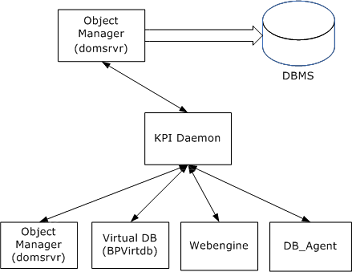
Each system KPI produce one of the following metric types:
System KPI Examples
- This example produces a count of the update requests sent to BOP Virtual Database:
updateCt
- This example reports how long requests for updates, inserts, and deletes to BOP Virtual Database took to complete:
virtdbUpdateResponseDt