

|
|
|
Rotate and backup mode links provide multiple paths through a network connecting two regions. This type of link can establish from two to eight sessions with the remote region. Each session is classified as active or backup (at least one session has to be defined as active). Individual sessions are allocated to different network routes through the use of the appropriate COS definitions.
Traffic between the two regions is sent across all the active links in rotation, and distributed equally across all the active sessions in the session group. If one of the active sessions is lost, then the first available backup session takes its place. When the active session is restored, the backup session is placed back in reserve.
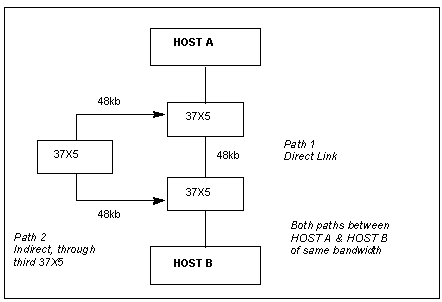
Example: Similar Bandwidth Paths
Rotate and backup links are appropriate in a network where there are two or more active physical network paths of similar bandwidth between two regions. A link is required that uses the aggregate bandwidth of all those physical paths, as shown in the following illustration.
Example: Different Bandwidth Paths
Rotate and backup links are appropriate in a network where there are two active physical paths of different bandwidth between the two regions. A link is required that uses the high-speed path exclusively but switches automatically to the slower path if the fast path fails. The following illustration shows such a configuration.
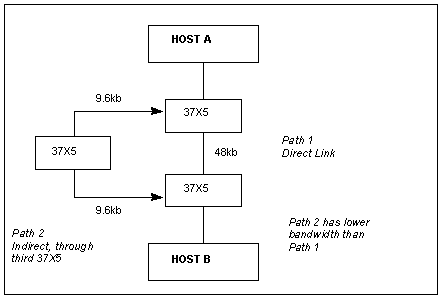
Rotate and backup links are not suitable for environments where the active sessions traverse different routes with widely differing transmission speeds. Take this into consideration when planning the COS definitions to be associated with the various sessions that form the INMC link.
We recommend that you configure each session to travel only on one virtual route. This configuration ensures that if a session is active its network path is always the same.
| Copyright © 2011 CA. All rights reserved. | Tell Technical Publications how we can improve this information |