User ID Security Exit Support › System Initialization Parameter List
System Initialization Parameter List
On entry to the security exit, Register 1 points to a list of ten full words, as shown in this diagram.
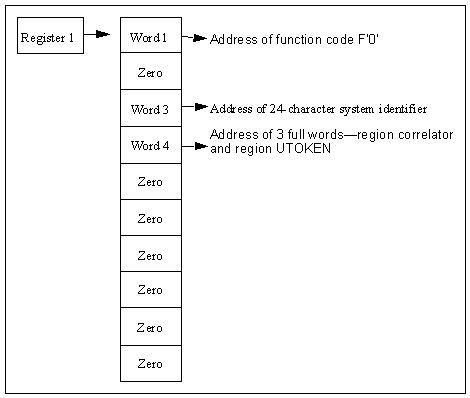
The contents of the parameter list are as follows:
- Word 1
Is a full word containing the address of function code F'0'.
- Word 2
Is set to zero.
- Word 3
Is a 24-character area containing the following:
- The 8-character primary ACB name field (padded to the right with blanks if necessary). The primary ACB name is as specified on the PRI JCL initialization parameter.
- Four blanks
- The 4-character system domain ID as coded on the NMDID initialization parameter. If the NMDID parameter is omitted the domain ID defaults to the first 4-characters of the primary ACB name used by your region (blank padded if required), or the ACB name itself if less than 5-characters long.
- The 4-character system user prefix as coded on the NMSUP initialization parameter. It defaults to the NMDID value if not coded.
- The 4-character product version, for example, V5.1.
These characters are passed to the exit to identify the system that is executing and might be regarded as the user ID of the system. The exit might want to know this to determine whether, for example, it is a production system.
- Word 4
Is the address of two full words. These are as follows:
- First word—can contain any value. This value is returned in the system closedown call, so it can be used as a region correlator. The exit can use this to relate this region to a set of control blocks or other information maintained by the exit in relation to the region.
- Second word—the region user token (UTOKEN), if one is available.
- Words 5 to 10
Are set to zeros.
Return Codes from Initialization Call
The exit must return a completion code in Register 15 on return. Successful initialization must be signified by return code F'0'. Your product region terminates if any other value is returned in Register 15 on completion of this call.
Copyright © 2010 CA.
All rights reserved.