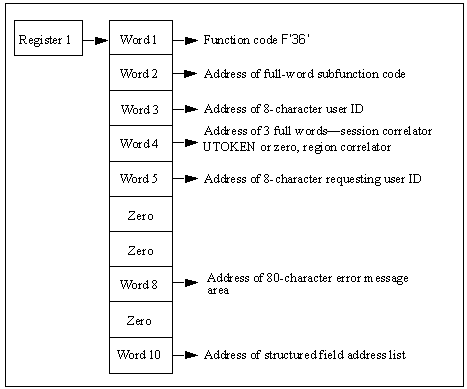
On entry to the security exit, Register 1 points to a list of ten full words, as shown in this diagram.
The contents of the parameter list are as follows:
Is a full word containing the address of function code F'36'.
Is the address of a subfunction code. The code defines the type of sequential call being requested and has values set as follows:
|
Subfunction Code |
Value |
|
F'0' |
Retrieve the next user definition following the key user ID (provided in word 3). The user ID for which information is being requested is the next user ID in the collating sequence. |
|
F'4' |
Retrieve the previous user definition preceding the key user ID (provided in word 3). The user ID for which information is being requested is the previous user ID in the collating sequence. |
Is the address of an 8-character field, blank-padded, containing the key user ID for the call, or set to zero if the request is issued for the first (next), or last (previous) user ID in the collating sequence.
Is the address of three full words containing the session correlator and the user token associated with the user issuing the request (not necessarily the correlator for the user ID whose information is being requested).
Is the address of an 8-character field containing the requesting user ID.
Is set to zero.
Is set to zero.
Is the address of an 82-character area into which the exit can place any error message text if the function request is denied or failed. Any text placed in this area is returned to the issuing procedure in the &SYSMSG system variable. If an error message is returned it must be formatted as follows:
Specifies the hexadecimal length of the message text (excluding these two bytes).
Specifies the error message text. Message text is converted to upper case.
Limits: 80 characters
Is set to zero.
If the request is honored, the exit must place in this word the address of a list of full words, terminated by X'FFFFFFFF'. Each full word in this list in turn points to a structured field that defines an item of information relevant to the user ID.
The exit must return a completion code in Register 15 on return. Completion codes are supported as described below. Causes for rejection are identified by error message text returned in the area addressed by word 8 of the parameter list.
The return codes listed below are the only codes that are accepted in response to the call. Any other return code is treated as return code 4.
Indicates that information is available. Word 10 of the parameter list points to an address list that provides pointers to structured fields describing the user ID.
Indicates that information is not available. An error message might be available in the 80-character area addressed by word 8 of the parameter list.