Data sharing between NTS regions is controlled by the manipulation of the attributes of ISR links between the systems. The types of data able to flow across an ISR link (that is, SAW or session data, or both) and the direction of flow (inbound or outbound) are determined by the values of ISR command parameters.
Because NTS-SI makes it possible to share SAW data between NTS systems in different networks, NTS has a reference network concept. Although a cross-network session is actually a single, logical connection, the session has a different appearance (due to alias names and network addresses) to VTAMs in each network. NTS commands that display or manipulate session information have a REFNET operand that allows a specific reference network ID to be specified.
It is possible to start an NTS region solely for the purpose of having it receive SAW and session data using ISR links; that is, you can disable data collection from the local VTAM. This is referred to as a dormant NTS region.
NTS-SI enables NTS to obtain SAW data for sessions that are unknown to the local VTAM. For SAW data sharing between NTS regions to occur, an ISR link must be active between the regions, with an NTS conversation currently enabled for the following:
It is possible for one NTS region to send and receive SAW data at the same time, but SAW data sharing terminates if one of the conditions required for transfer is disabled.
To facilitate the operation of SAW data sharing, the ISR command supports specialized parameters that are valid for NTS conversations only.
NTS regions determine which SAW data is available for sharing with other regions, on the basis of the following rules (some rules are dependent on whether the link is cross-network or cross-domain):
SAW data is forwarded to another NTS region only if it is not accessible to the VTAM in that domain. (NTS is able to determine whether SAW data for a particular session is visible to the VTAM in another domain.)
The application of this rule means that no unnecessary ISR traffic is generated.
Note: Applies to all link types.
SAW data is available for forwarding only if it was received from the local VTAM. This means that, for an NTS region to see all network activity in a particular domain, one of the following must be true:
Note: Applies to cross-domain links only.
SAW data is available for forwarding only if it was collected from the local VTAM, or from an NTS region in the same network as the local VTAM. This means that SAW data received across ISR can be forwarded to an NTS region in another network, provided that the data was derived from an NTS region in the local network. A corollary to this is that SAW data received from an NTS region in another network cannot be forwarded.
Note: Applies to cross-network links only.
A single NTS region can receive SAW data from one NTS region in another network at any one time. Any attempt to enable multiple ISR links for SAW data receipt from multiple NTS regions in other networks fails.
This rule enforces a gateway concept, where SAW data is sent to a central NTS region in one network before being forwarded to an NTS region in another network.
Note: Applies to cross-network links only.
When an NTS region detects that SAW data sharing with another NTS region has terminated for any reason, it purges from storage any SAW data that was received exclusively from that region. This precaution is taken in case the data is no longer up to date. In this way, the image presented by NTS is kept accurate and current.
Unless NTS-SI is operating, complete session data may not be available to an NTS region (even if one of the session partners is in the local domain).
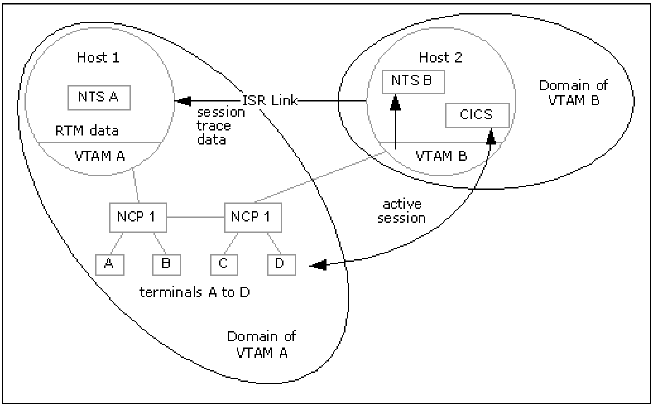
You may have a situation where accounting and trace data are only accessible using the local VTAM, even though cross-domain SAW data is easily accessible to NTS regions running in different domains that are linked by ISR. In addition, RTM data can be collected in the domain in which the controller is defined only. Therefore, in the case of a cross-domain session between an application and a remote terminal, one NTS region has access to the accounting and trace data, and another has access to the response time information for the same session. If you are using NTS-SI, you nevertheless have access to all the session data—accounting, trace, and response time—for any session visible to either VTAM.
The following illustration shows how trace data can be captured from another domain.
Note the following in this illustration:
You request session data by using the ISR command. For session data sharing between NTS regions to occur, the following conditions must exist:
An ISR link must be active between the regions, with an NTS conversation currently enabled for these types of data transfer and receipt:
It is possible for one NTS region to send and receive session data at the same time, but session data sharing terminates if one of the conditions required for transfer is disabled.
NTS regions determine which session data is available for sharing with other regions on the basis of the following rules (some rules are dependent on whether the link is cross-network or cross-domain):
Session data is forwarded to another region only if it is likely to be unavailable to the other region. In some cases, session data is visible to the two VTAMs in two different domains, and therefore to the NTS regions running in these domains.
NTS is able to determine whether the data is visible in more than one domain, and whether the NTS in the other domain is likely to be collecting data for this session or not.
Note: Applies to all link types.
Session data is available for forwarding only if it was collected by the local VTAM from the local domain. Session data received from another region is not kept in storage but handled in one of the following ways:
Note: Applies to cross-domain links only.
Session data received from a cross-domain ISR link can be forwarded to an NTS region in another network, provided that the receiving NTS region verifies that SAW data relating to this session has been forwarded to the cross-network NTS region.
This means that the gateway NTS region performs a routing role, to ensure that:
Note: Applies to cross-network links only.
Session data sharing is implemented by the following separate transaction types or flows that can occur in the scope of a single session:
When an NTS region receives trace or RTM data for a session for the first time, or when the NTS region becomes aware that accounting data for a session needs to be collected, it checks to see whether either of the following is true:
If an NTS region accepts a data available notification, it indicates the availability of this data on any NTS Session List display as follows:
You can initiate session data sharing after session awareness has been activated in the sending region. In this case, session data may already have been collected. When the sending region detects that session data sharing with another region has become active, it sends data available notifications to this region for the sessions for which data has been collected.
If an NTS region detects that session data sharing with another region has been terminated for any reason, it resets the session data present indicators that were set exclusively in response to session data available notifications received from that other NTS region. This is because the data can no longer be solicited.
After an NTS region has received notification of data availability, it can send a solicitation request to the collecting region to view all or part of the data. This occurs when a user requests a particular display. The solicitation requests that the collecting region immediately forward a reply containing all collected data of the specified type.
Session data received in reply to a solicitation request appears immediately. When the user exits the display, the data is discarded. Another user request to view the session data results in another solicitation. Refreshing the current display also discards the current data and issues another solicitation. In this way, NTS guarantees that the data displayed is the most recent (and therefore most accurate) available and that the data is actually stored in one location in the network only.
When an NTS region detects the end of a session, the following processing occurs:
When session data arrives from another NTS region, the receiving region determines whether this session data was requested or not. Any data that was not requested is discarded. If the data was requested, then it is immediately logged to the NTS database or user exit (or both, depending on what is requested) and the session and accompanying data is purged from storage.