The Multiple Application Interface (MAI) component of CA SOLVE:Access enables you to operate multiple sessions simultaneously
Note: For more information about MAI, see the CA SOLVE:Access User Guide or the CA SOLVE:Access Administrator Guide.
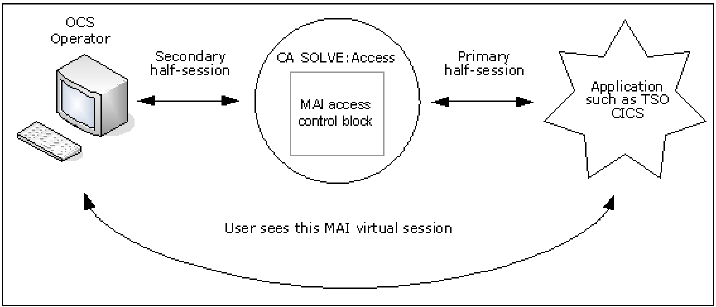
An active MAI session consists of two real SNA sessions. MAI relates these sessions by transferring data received for one session across to the other. The result is that, to the user, the endpoints of two distinct sessions appear to be in session with one another.
For identification, the sessions related by MAI are termed the primary and secondary half-sessions of an MAI virtual session. These half-sessions, which are transparent to the MAI user, comprise the following elements:
The following illustration show this MAI Session process.
VTAM presents NTS with SAW data for each of the MAI half-sessions, but is unaware that they are logically related. MAI, using the NTS/MAI interface, advises NTS that the half-sessions are logically related.
This relationship is presented on a special MAI Session Configuration panel. (You can display a Session Configuration panel for each of the half-sessions.)
Note: For more information about the NTS Session Configuration panel, see the User Guide.
When active, NTS is aware of all real sessions that have at least one partner in its domain. Using the NTS/MAI interface, MAI provides NTS with information about the logical relationship between the real half sessions that form the MAI virtual session or sessions.
From this, NTS builds information from the two half sessions into a single virtual session. This virtual session can be listed, selected, and displayed in the same manner as real sessions in NTS.
No RTM data is collected or available for MAI sessions.
You can implement the NTS and MAI features in different domains on the same host. To route MAI data across ISR, ensure that the following conditions are met:
The NTS ISR link is configured for unsolicited message flow from the domain where MAI is resident, to the domain in which NTS is active.
When an MAI session is logged to the NTS database, NTS checks if any trace or accounting data, or both, is flagged as available for the MAI session. If this is the case, NTS logs the trace or accounting data (or both) collected for the primary half session with the MAI session incidence record. (This avoids the need to log the primary half session to the database if the MAI session is the preferred record of the session incidence.)
The user ID of the user who started the MAI session is provided by the MAI/NTS interface. This data is passed to the NTS user exit in an additional field added to the session configuration section of the type 39 SMF record. This field contains nulls for non-MAI sessions.