

|
|
|
The IBM® product, WebSphere, includes two foundation products and several foundation extensions. The two products that represent the heart of the product set are WebSphere MQ and WebSphere Application Server (WAS). WAS is what most people think about today when you say WebSphere. WebSphere Application Server is a Java2 Enterprise Edition (J2EE) compliant application server, which means WAS supports the J2EE specification and builds on the J2EE specification.
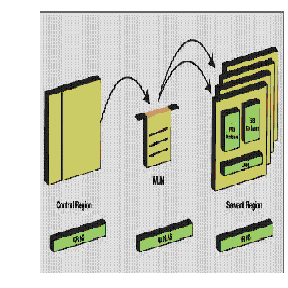
WAS for z/OS has a Server side and a Client side. A Server comprises a Control Region and one or more corresponding Server Regions. The Control Region is a system address space. No application code runs there. The Control Region manages communications into and out of the server, authenticates all client requests, keeps track of the client transactions, and interfaces with Workload Manager (WLM) to schedule the work.
A Servant Region is an application address space where an application and its objects run. Between the Control and Servant Regions is a work queue that is administered by Workload Manager. WLM prioritizes the requests and dispatches them to a Servant Region to meet performance targets that the user has defined.
When an application is deployed, the user specifies the WAS server in which the application will execute.
| Copyright © 2011 CA. All rights reserved. | Tell Technical Publications how we can improve this information |