

|
|
|
In a single system, z/OS lets only one task at a time have exclusive access to a resource and creates a queue of outstanding ENQ requests if the resource is not available. As the resource becomes available, z/OS lets the task that issued the next ENQ request obtain control of that resource. z/OS uses the RESERVE facility to protect resource integrity across system boundaries. When a task needs a global-type resource, the task issues a special type of ENQ request that identifies the resource and the unit control block (UCB) address of the DASD device on which that resource resides.
When the task obtains control of the resource, z/OS issues a hardware reserve for the device where the resource is located. While a hardware reserve is outstanding, tasks on other systems cannot access the reserved device even if they need resources on that device that are different from the resource held by the reserving task. This type of lockout can degrade system performance.
Note: Tasks on the system holding the reserve can still access other resources on the device.
GDIF ensures resource integrity and improves system performance by propagating ENQ and RESERVE requests as global ENQ requests to all systems in your complex. When GDIF intercepts an ENQ or RESERVE request, it sends a record of that request to the CA MIM control files where other systems can access this information. Each system has complete information about which resources are being used, so tasks on different systems cannot update the same resource at the same time.
By propagating ENQ requests to all systems, GDIF provides cross-system integrity for resources not typically protected by hardware reserves. This allows more sharing of resources between systems. By converting hardware reserves to enqueues and propagating them to all systems, GDIF improves system performance. The following figure illustrates how GDIF ENQ processing enhances z/OS ENQ processing and shows how GDIF improves integrity while ensuring serialization:
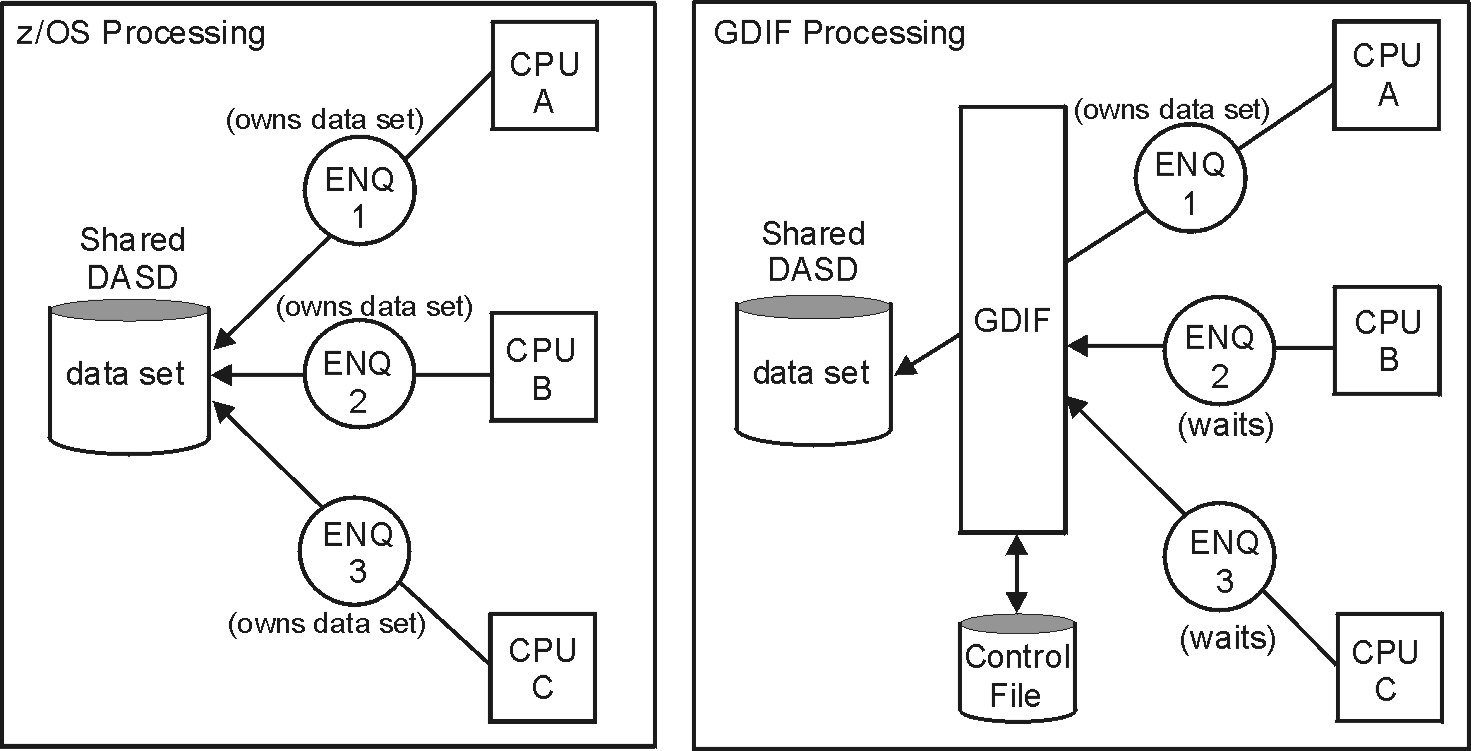
GDIF also eliminates many occurrences of the deadly embrace. A deadly embrace occurs when tasks on different systems cannot complete because they each hold resources or devices needed by the other to complete. When GDIF propagates RESERVE requests as global ENQ requests, z/OS serializes access to the resource on all systems without locking tasks out of the devices containing the resources. You can tell GDIF to eliminate hardware reserves so that the possibility of deadly embraces or lockouts is diminished greatly.
| Copyright © 2012 CA. All rights reserved. | Tell Technical Publications how we can improve this information |