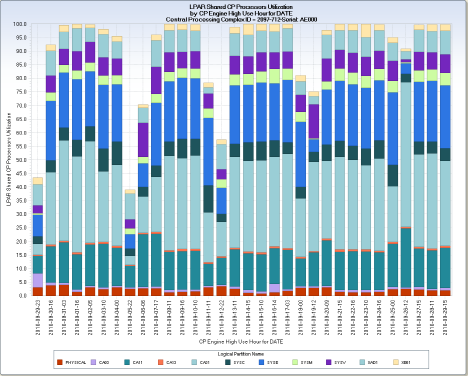
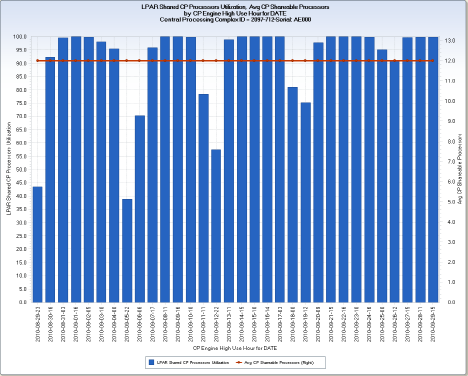
The RMFEHH query shows the peak hour of dispatch, over the past 32 days, for each engine type (CP, zIIP, zAAP, IFL, ICF) in the shared LPAR engine pools. The query generates two dispatch charts for each engine type in each Central Processing Complex (CPC).
The example shows the two charts generated for the shared CP engine pool of an IBM z/10 2097-712 CPC. The top chart shows the peak hour, per day percent utilization of the CP engine pool, with the breakdown of the various LPARs that use CP engines. The second chart shows the same information, minus the LPAR breakdown. The chart includes a reference line (right Y-axis) that shows the number of engines in the CP engine pool (12 engines in this example). The X-axis shows the date concatenated to the high use hour. In the example, the first vertical bar shows that the peak CP engine dispatch occurred on August 29th, 2010 (a Sunday) during hour 23: "2010-08-29-23"—when the utilization of the CP engine pool was about 43 percent.
A similar set of charts is created for each engine type, one where the vertical bars show individual LPAR percent utilization, and the other showing percent utilization plus the physical engine count for the engine type.
This query is used to examine the peak utilization load for the CPC shared engine pools over the past month. Consistent peak hour utilization at, or near 100 percent means that, for at least 1 hour each day an engine pool has reached the utilization limit. It is likely that some workloads are being delayed, or receiving suboptimal attention. Consistent peak hour utilization significantly below 100 percent utilization means that you have invested more than necessary in a particular engine type.
CPC Shared CP Pool Pct Use by LPAR HH
LPCPCSSU - LPAR Shared CP Processors Utilization
A user step analyzes HARLPC file data to determine the specific hour for each day where the Central Processing Complexes CP engines in the shared engine pool were most heavily dispatched. Once determined, the percent utilization of each LPAR using the CP engine pool during that peak hour is stacked in a vertical bar using data element LPCPCSSU.
CP_DDHH - CP Engine High Use Hour for DATE
Data element CP_DDHH is derived by appending the high use hour to the date, in the form:
YYYY-MM-DD-HH (for example, 2010-08-31:22, meaning hour 22 of August 31st, 2010).
CPC Shared CP Pool Pct Use High Hour
LPCPCSSU - LPAR Shared CP Processors Utilization
The same overall shared CP engine pool utilization as shown in the previous data extract, without the individual LPAR breakdown. LPCPCSSU is summarized to the CPC level.
PRSMACSP - Avg CP Shareable Processors
Data element PRSMACSP shows the average number of CP engines in the shared pool for the high use hour. If the number of physical engines in the shared CP pool changes, this value changes over the days plotted.
CP_DDHH - CP Engine High Use Hour for DATE
Data element CP_DDHH is derived by appending the high use hour to the date, in the form:
YYYY-MM-DD-HH (for example, 2010-08-31:22, meaning hour 22 of August 31st, 2010).
Note: This query generates eight additional data extracts, two for each of the four other engine types, ICFs, IFLs, zAAPs, and zIIPs. The charts, and methods used to generate them are identical to those used to build the CP engine pool charts. The remaining data extract documentation lists the specific data elements used for the left and right Y-axis:
LPCPCSIU - LPAR Shared ICF Processors Utilization
LPCPCSIU - LPAR Shared ICF Processors Utilization
PRSMAISP – Avg ICF Sharable Processors
LPCPCSNU - LPAR Shared ICF Processors Utilization
LPCPCSNU - LPAR Shared ICF Processors Utilization
PRSMANSP – Avg ICF Sharable Processors
LPCPCSZU - LPAR Shared zAAP Processors Utilization
LPCPCSZU - LPAR Shared zAAP Processors Utilization
PRSMAZSP – Avg zAAP Sharable Processors
LPCPCSDU - LPAR Shared zIIP Processors Utilization
LPCPCSDU - LPAR Shared zIIP Processors Utilization
PRSMASSP – Avg zIIP Sharable Processors
xx_DDHH = PUT(YEAR4,Z4.) || '-' || PUT(MONTH,Z2.) || '-' ||
PUT(DAY,Z2.) || '-' || PUT(MAXxxH,Z2.) ;DATEPART(ENDTS)
xx Engine High Hour for DATE element derived for each engine type (xx)
TRIM(LPCMOD)||'-'||TRIM(CPCMODID)||'-Serial: '||SUBSTR(CPCSEQNB,12,5);
The following modifications can be made to the RMFEHH query:
| Copyright © 2011 CA. All rights reserved. | Email CA Technologies about this topic |