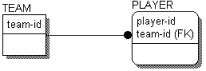
In IDEF1X notation, the type of the relationship that connects two entities enforces the concept of dependent and independent entities. If you want a foreign key to migrate to the key area of the child entity (and create a dependent entity as a result), you can create an identifying relationship between the parent and child entities. A solid line connecting the entities indicates an identifying relationship. In IDEF1X notation, the line includes a dot on the end nearest to the child entity, as shown in the following figure:
In IE notation, the line includes a crow's foot at the end of the relationship nearest to the child entity:
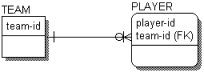
Note: Standard IE notation does not include rounded corners on entities. This is an IDEF1X symbol that is included in IE notation to ensure compatibility between methods.
As you may find, there are advantages to contributing keys to a child entity through identifying relationships in that it tends to make some physical system queries more straightforward, but there are also many disadvantages. Some advanced relational theory suggests that contribution of keys should not occur in this way. Instead, each entity should be identified not only by its own primary key, but also by a logical handle or surrogate key, never to be seen by the user of the system. There is a strong argument for this in theory and those who are interested are urged to review the work of E. F. Codd and C. J. Date in this area.
| Copyright © 2011 CA. All rights reserved. | Email CA Technologies about this topic |