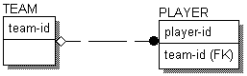
A non-identifying relationship also connects a parent entity to a child entity. But, when a non-identifying relationship connects two entities, the foreign key migrates to the non-key area of the child entity (below the line).
A dashed line connecting the entities indicates a non-identifying relationship. If you connect the TEAM and PLAYER entities in a non-identifying relationship, the “team-id” migrates to the non-key as shown in the figure below:
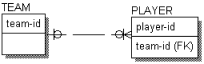
Since the migrated keys in a non-identifying relationship are not part of the primary key of the child, non-identifying relationships do not result in any identification dependency. In this case, PLAYER is considered an independent entity, just like TEAM.
However, the relationship can reflect existence dependency if the business rule for the relationship specifies that the foreign key cannot be NULL (missing). If the foreign key must exist, this implies that an instance in the child entity can only exist if an associated parent instance also exists.
Note: Identifying and non-identifying relationships are not a feature of the IE methodology. However, this information is included in your diagram in the form of a solid or dashed relationship line to ensure compatibility between IE and IDEF1X methods.
| Copyright © 2011 CA. All rights reserved. | Email CA Technologies about this topic |