

|
|
|
Non-identifying relationships contribute keys from a parent to a child entity. However, by definition, some (or all) of the keys do not become part of the key of the child. This means that the child will not be identification-dependent on the parent. Also, there can be situations where an entity at the many end of the relationship can exist without a parent, that is, it is not existence-dependent.
If the relationship is mandatory from the perspective of the child, then the child is existence-dependent on the parent. If it is optional, the child is neither existence nor identification-dependent with respect to that relationship (although it may be dependent in other relationships). To indicate the optional case, IDEF1X includes a diamond at the parent end of the relationship line and IE includes a circle.
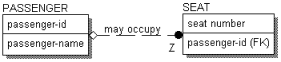
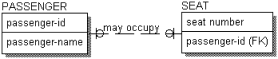
In this figure, the attribute “passenger-id” is a foreign key attribute of SEAT. Since the “passenger-id” does not identify the SEAT, it identifies the PASSENGER occupying the SEAT, the business has determined that the relationship is non-identifying. The business has also stated that the SEAT can exist without any PASSENGER, so the relationship is optional. When a relationship is optional, the diagram includes either a diamond in IDEF1X or a circle in IE notation. Otherwise, the cardinality graphics for non-identifying relationships are the same as those for identifying relationships.
The cardinality for the relationship, indicated with a Z in IDEF1X and a single line in IE, states that a PASSENGER <may occupy> zero or one of these SEATs on a flight. Each SEAT can be occupied, in which case the PASSENGER occupying the seat is identified by the “passenger-id,” or it can be unoccupied, in which case the “passenger-id” attribute is empty (NULL).
| Copyright © 2011 CA. All rights reserved. | Tell Technical Publications how we can improve this information |