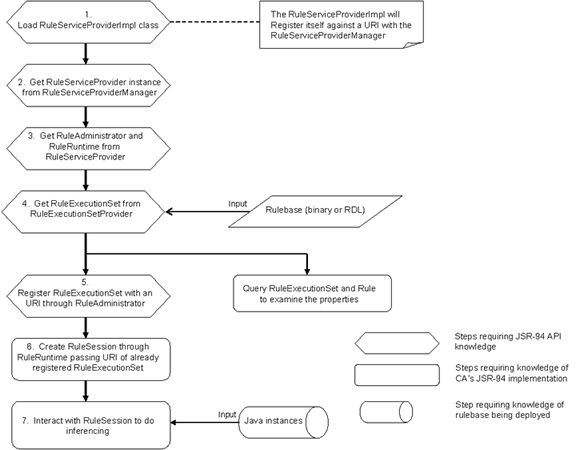
All JSR-94 client applications follow a similar basic flow. The following chart explains how a Java client application works with the JSR-94 interface.
How these steps are distributed in the client application is a matter of architectural design. In one common solution architecture, all the preceding steps may be implemented in a single Java application. In another solution architecture, the steps through registering the RuleExecutionSet using the RuleAdministrator may be performed in one client program, such as an admin application, while querying RuleExecutionSets for property information and inferencing with those RuleExecutionSets may be performed in a different client application, i.e. the business application.
For more information about the steps in the flow chart, see Acquire the RuleServiceProvider (step 1), Acquire and Register the RuleExecutionSet (steps 2 - 5), Establish a Rule Session (step 6), and Addition and Retrieval of Inference Objects (step 7). For more information about querying RuleExecutionSets and Rules, see Query RuleExecutionSets and Rules.
For a detailed example of an actual client application, see Client Application Class.
Note: Implementing some steps requires knowledge of the pure JSR‑94 API while other steps require specific knowledge of CA Rule Engine. Knowledge of how to interface with the rulebase is also required. For more information on obtaining information about the interface of the rulebase, see Rulebase Structures.
| Copyright © 2009 CA. All rights reserved. | Email CA Technologies about this topic |